

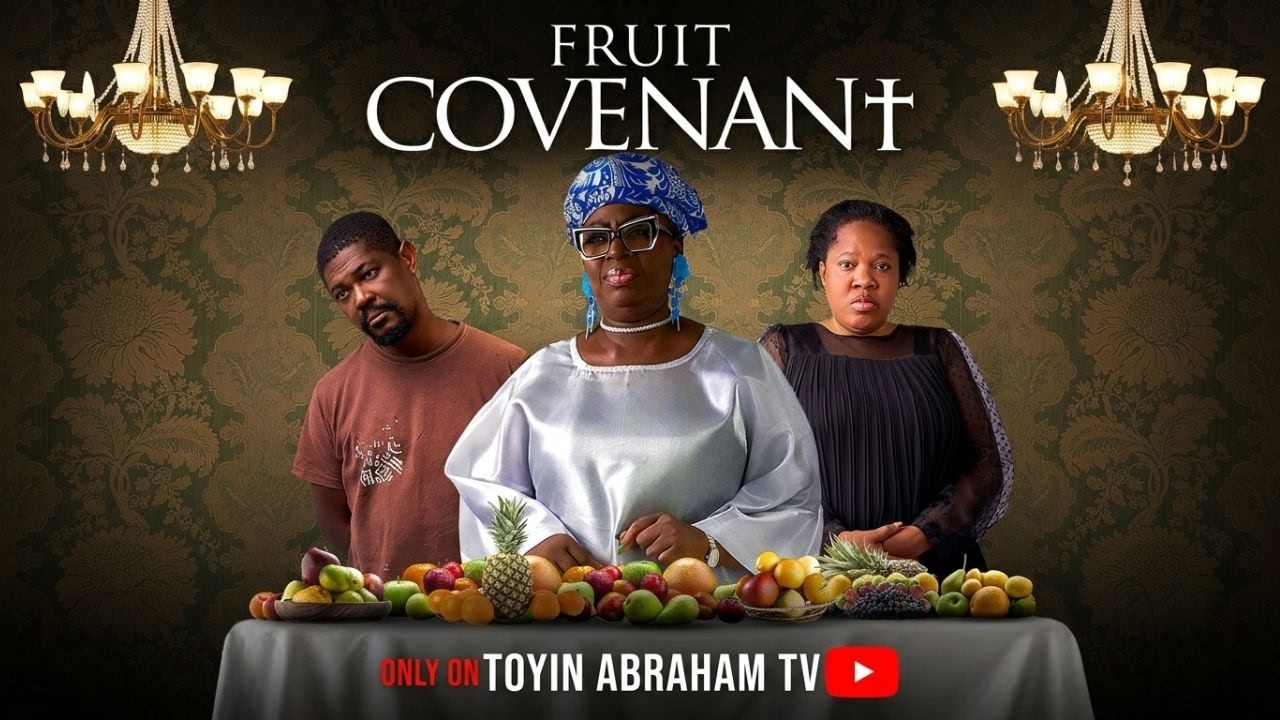
Wealth has a price. It is either built on the altar of hard work, smart work, or spiritual means. Everyone has an altar, though we may never truly know the foundation upon which it stands or the covenant that sustains it. This is the central question that Fruit Covenant, produced by Toyin Abraham Ajeyemi, seeks to explore: what are people willing to sacrifice in their desperate pursuit of a better life?
The film introduces us to Adun (Toyin Abraham Ajeyemi), a resilient woman trying to keep her family afloat amidst crushing poverty. She is married to Adekunle (Olarotimi Fakunle), a struggling keke rider whose ageing tricycle seems to consume whatever little income he manages to make. Together, they are raising three daughters—Favour (Miracle Ojorale), Desire (Abisola Salami), and Miracle (Hejiwumi Akewi)—in a cramped one-room apartment that serves as both home and symbol of their socioeconomic reality.

From the opening scenes, the film paints a vivid portrait of hardship. Adun survives by selling fruits, while Adekunle battles daily with a livelihood that offers little hope of financial stability. Yet, despite their circumstances, the family remains remarkably united. Their poverty has not extinguished their humanity, nor has it robbed them of hope. They continue to dream, pray, and labour for a better tomorrow. It is Adun, however, who emerges as the emotional centre of the story. Her determination to keep the family together, her optimism in the face of adversity, and her unwavering belief that things will eventually improve make her a character many viewers can relate to.
ALSO READ: Deja’s Scream Review: The Pain of a Boy Taught That Men Should Never Cry
The narrative takes a significant turn when Adun secures employment as a housekeeper in the home of Mrs Coker (Jumoke George), a wealthy woman whose life appears to embody everything Adun longs for. Fascinated by Mrs Coker’s affluence and intrigued by the altar at which she regularly worships, Adun begins to desire not merely financial comfort but the very life Mrs Coker seems to possess. Her prayers gradually shift from seeking God’s purpose for her life to yearning to become like another person.
This transition forms one of the film’s strongest thematic concerns. The story warns against the danger of comparing one’s journey with another person’s. Yet, while the message is compelling, the screenplay’s execution leaves room for criticism. The film moves rather quickly from Adun’s struggles to her eventual indoctrination into the cultic system that promises wealth. As a viewer, I expected a more gradual progression. It would have been more convincing if the narrative had shown Mrs Coker repeatedly rescuing Adun from difficult situations, providing financial support, or becoming a dependable source of relief. Such moments would have better justified Adun’s growing admiration and eventual susceptibility.
Instead, the transformation happens after what appears to be a single significant encounter. The suddenness slightly weakens the emotional weight of her decision. Nevertheless, one could argue that years of accumulated frustration, disappointment, and deprivation had already eroded her resistance. Desperation often makes people vulnerable to promises they would ordinarily reject. In that regard, the film still succeeds in making Adun’s choice understandable, even if the journey to that choice feels somewhat rushed.
Toyin Abraham delivers a convincing performance as a woman torn between contentment and ambition, faith and desperation. She captures the emotional exhaustion of poverty with remarkable authenticity. Olarotimi Fakunle complements her performance effectively, portraying a husband who is trying his best despite circumstances constantly working against him. Jumoke George also brings an unsettling calmness to Mrs Coker, a character whose wealth conceals a darker spiritual reality.
Beyond its supernatural elements, Fruit Covenant is ultimately a morality tale. It explores the consequences of envy, the dangers of coveting another person’s destiny, and the spiritual implications of careless speech. One of the film’s most profound lessons is that words carry weight. They are not merely sounds released into the air; they possess the power to shape realities, influence decisions, and determine outcomes.
This lesson becomes particularly evident when Adun pledges “all her fruits” in exchange for the prosperity she desires. She interprets the statement literally, believing it refers to the fruits she sells for a living. What she fails to understand is that language often carries deeper meanings. The “fruits” demanded from her are not mangoes, oranges, or pineapples, but the children she has brought into the world. The tragedy lies not only in the covenant itself but also in her failure to reflect carefully on the words she uttered. The film reminds viewers that speech requires caution and that some promises, once made, cannot easily be withdrawn.
Perhaps the most enduring message of Fruit Covenant is found in its reflection on identity and purpose. A mango tree was created by God to be a mango tree and to produce mangoes. It does not struggle to become an orange tree, nor does it compare itself to neighbouring trees. It fulfils its purpose by bearing the fruit it was designed to bear. In much the same way, every individual has a unique assignment, a distinct path, and a particular destiny.
ALSO READ: ‘Love in Ghetto’ Review: A Familiar Nollywood Romance Too Predictable in its Uneven Storytelling
The moment we begin measuring our lives against those of others, we risk losing sight of who we were created to become. The film’s warning is simple but powerful: run your own race. Stay in your own lane. That lane may appear narrow or insignificant when compared to someone else’s, but God has already placed purpose, grace, and destiny within it. Success is not becoming another person; it is becoming everything God created you to be.
While Fruit Covenant occasionally sacrifices narrative depth for the sake of its message, its moral lessons remain relevant and thought-provoking. It is a film that challenges viewers to examine the source of their desires, the consequences of their choices, and the dangers of seeking shortcuts to prosperity. More importantly, it reminds us that not every altar is worth approaching and that not every covenant is worth making.
Fruit Covenant is streaming on Toyin Abraham TV.


