

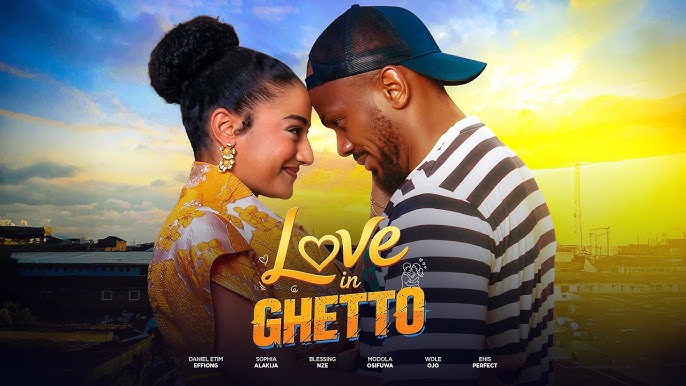
Love in Ghetto follows Zara (Sophia Alakija), the only daughter of billionaire politician Chief Nelson (Patrick Doyle) and a former model. Determined to secure political advantage, Chief Nelson wants Zara married off to an unemotional Tobe (Wole Ojo). Fate, however, intervenes when Zara accidentally crosses paths with Solomon (Daniel Etim-Effiong), a struggling artist who sells paintings by the roadside. One encounter leads to another. Solomon creates a portrait of Zara; the artwork goes viral online, and she suddenly finds herself basking in a level of public attention she had never experienced before. More conveniently, she finds comfort and companionship in Solomon’s presence. They share meals, watch football together, and even sell artworks side by side.
As their bond grows, Tobe becomes increasingly uncomfortable with the friendship. Meanwhile, Isila (Modola Osifuwa), whose characterization is a clear caricature of Omoladun Kenkelewu (the late Monsurat Omidina, wife of Baba Suwe), develops an intense crush on Solomon. She openly calls him her boyfriend, an appellation Solomon is oblivious of. What causes her fondness for Solomon is his frequent visits to her canteen for meals.

At its core, Love in Ghetto attempts to blend romance, class conflict, family expectations, and political ambition into a familiar Nollywood love story. The film also gestures towards themes of dignity, integrity, social mobility, and the tension between wealth and personal values. However, while these thematic ambitions are admirable, the execution often struggles under the weight of uneven storytelling.
One of the film’s most noticeable weaknesses is its handling of narrative continuity. After Zara nearly runs Solomon over while he is selling paintings, she steps out of her car to apologise. Solomon dismisses the apology and tells her to leave. The very next scene shows Solomon browsing through Zara’s Instagram page before deciding to draw her portrait. This raises an immediate question: how exactly did he find her social media profile? The screenplay offers no explanation. Even more puzzling is what follows. There is no meaningful narrative bridge showing how the two reconnect after the portrait is completed. Yet Zara suddenly appears in Solomon’s house, inside his room, seemingly without hesitation or concern. The leap feels abrupt and unearned, creating a gap that the audience is left to fill on its own.

The film’s attempt at suspense is perhaps where it falters most significantly. It desperately wants viewers to question who is behind Solomon’s kidnapping and the obstacles standing in Zara’s way. Unfortunately, the mystery never gains traction. From the moment Solomon is abducted, and Tobe is conveniently brought back into Zara’s life by her father, it becomes glaringly obvious who is orchestrating events. The supposed revelations lack dramatic impact because the film reveals its hand far too early. Instead of suspense, what emerges is predictability.
The police investigation subplot further weakens the film’s credibility. Isila becomes a suspect largely because of threatening remarks that her friend Bimpe (Blessing Jessica Obasi) reported to the police. Yet the entire line of investigation borders on the absurd. The notion that a roadside canteen owner could execute a murder, dispose of a body without leaving any trace, and evade detection with such ease stretches plausibility beyond reasonable limits. Rather than generating tension, the subplot invites skepticism.
ALSO READ: MOVIE REVIEW: The House Manager reminds you that rich homes hide the worst things
The performances, however, provide some relief from the screenplay’s shortcomings. Daniel Etim-Effiong brings warmth and sincerity to Solomon, making the character’s humility and resilience believable. Sophia Alakija effectively captures Zara’s vulnerability beneath her privileged upbringing, while Patrick Doyle convincingly embodies the calculating politician whose personal relationships are subordinate to his ambitions. Wole Ojo as Tobe delivers a restrained performance that aligns with the emotionally detached nature of his character, though this same restraint sometimes makes him feel distant and underwritten rather than fully compelling. Blessing Jessica Obasi as Bimpe also adds some presence in her limited screen time, but the character is not developed enough for her performance to carry significant dramatic weight. Modola Osifuwa injects comic energy into the narrative, though her role often leans more toward comic relief than toward a fully fleshed-out character.
The film’s treatment of dignity is perhaps its most interesting thematic thread. Solomon consistently refuses to allow poverty to compromise his self-respect. He rejects Zara’s monetary compensation for the artwork he freely created for her and later turns down a staggering ₦30 million offer from Zara’s father to walk away from their relationship. The film clearly wants these moments to symbolise integrity triumphing over material temptation. Yet this is also where the story slips into familiar Nollywood romantic idealism. The gesture feels less like a believable human decision and more like a well-worn genre convention designed to prove the purity of love. As a result, the emotional impact does not land as convincingly as intended.
The climax introduces another logical inconsistency that is difficult to overlook. After Solomon is abducted, he is thrown into a river and later explains that a fisherman rescued him. While survival itself is not impossible, the circumstances surrounding it raise questions. The men hired by Zara’s father were armed. If their objective was truly to eliminate Solomon, it would have made far more sense for them to ensure he was dead before disposing of his body. The film never adequately addresses this contradiction, leaving the sequence feeling more like a convenient plot device than a believable turn of events.
In the end, Love in Ghetto is a film with recognisable themes and a capable cast, but it is undermined by narrative shortcuts, weak suspense, and several lapses in logic. Its exploration of love across class divides and the preservation of personal dignity offer moments of genuine interest, yet these strengths are frequently overshadowed by plot developments that demand too much suspension of disbelief. The result is a film that remains watchable but never fully realises the dramatic and emotional potential of its premise.
Love in Ghetto is streaming on Ibaka TV on YouTube.


