

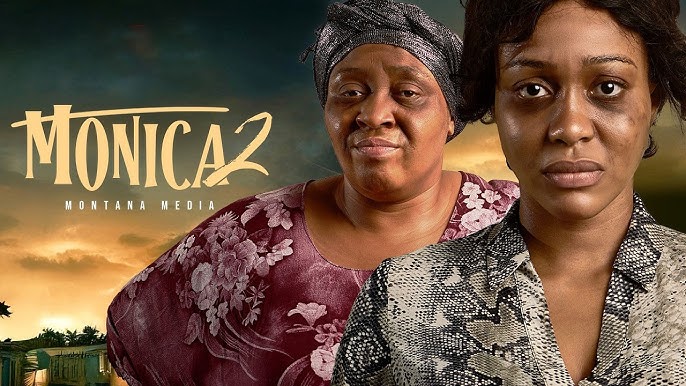
When I finished seeing Monica, I felt some relief, and I wrote a review of it in that state of quiet satisfaction. At the time, I didn’t know there was going to be a second part. In fact, I actually wished there wasn’t a continuation, because, to me, the story had ended neatly as it should. It had that rare kind of closure that doesn’t beg for extension. But then again, the Nigerianness in all of us, the collective instinct that justice must be seen and felt, kept pushing for more. People wanted karma to catch up with those who hurt Monica (Uche Montana), those who treated her unfairly, especially her mother (Blessing Onwukwe) and Pascal (John Ekanem). That desire is almost cultural; we want the emotional books balanced, not just closed.
ALSO READ: ‘Monica’ Review: A Story That Questions Karma, Goodness, and the Cost of Choosing Yourself
So when Monica 2 arrived, it did not come quietly. It came with anticipation and expectation, and with over five million views in less than 24 hours. That alone says something about how deeply the first part connected with its audience. But beyond the numbers, what struck me immediately was the narrative decision to pivot. What Monica had at the end of part one was a dream, and when I saw that, I said, yes, this is a great twist. It doesn’t just continue the story, it resets it. It allows the film to begin again on a fresh emotional and psychological note, almost like giving both the character and the audience a second chance to confront the same realities, but differently.
If Monica I felt like a climax, the emotional peak where everything converges, then Monica II operates as a resolution. Not just a resolution in the conventional sense of tying loose ends, but a deeper and more reflective closure. It interrogates the consequences of everything that came before. It asks what happens next, and more importantly, how do we live with it.
One of the strongest thematic threads in Monica 2 is its treatment of black tax, especially within the Nigerian context. For a society that prides itself on communal living, shared burdens, and collective progress, black tax should not feel like a curse. Yet, the film lays bare the darkness that often surrounds it. It shows how what should be an act of support and solidarity becomes a mechanism of control, guilt, and emotional exploitation. Parents and guardians, knowingly or unknowingly, place enormous financial burdens on children who are barely finding their footing. Worse still, this burden often comes wrapped in entitlement and ingratitude.
ALSO READ: ‘Mirrors and Reflections’ Review: Emotional, Engaging, but Not Fully Convincing
This is why both installments of Monica resonate so strongly. The film does not outright condemn the black tax. That would be too simplistic. Instead, it offers something more nuanced, a map. A way to navigate these complex family expectations without completely losing oneself. It suggests that a family that truly values you would want to see you fly, not crawl under the weight of their demands. That distinction is crucial.
An average human being knows the difference between right and wrong, and the film subtly reinforces this through Monica’s siblings. Their awareness, even when they act selfishly, shows that exploitation is often a choice, not ignorance. When people gaslight you into sacrificing your own growth for their comfort, they are sending a very clear message: “We are drowning, let’s all drown together. How dare you be different!” And the film captures how this message is delivered in different ways. Sometimes loudly, through direct accusations of wickedness or selfishness, and sometimes subtly, through cycles of apology followed by fresh demands.
What makes this portrayal particularly unsettling is how it strips away the illusion of familial love. These characters, in their worst moments, do not see Monica as a human being with limits and dreams. They see her as a tool, as tissue paper, something to be used and discarded. It is harsh, but it is honest.
And then there is the question of love. The film insists, quietly but firmly, that love is action. Action speaks louder than words. It is not enough to say “I love you” if that love does not protect, support, or even acknowledge the other person’s humanity. In this light, love that is silent and passive becomes just as damaging as outright hatred. This is where Monica’s father becomes such a frustrating figure. For most of the film, his silence renders him almost irredeemable. He exists, but he does not act. And in a story like this, inaction is complicity.
Yet, when he finally does act, his intervention triggers something important, an epiphany, a shift, a quiet revolution within Monica. It is not loud or dramatic, but it is decisive. It pushes her towards a new understanding of herself and her relationships.
This revolution is perhaps the most important outcome of Monica 2. It teaches her, and by extension the audience, that forgiveness and memory can coexist. You can forgive without forgetting. You can love without losing yourself. And sometimes, the healthiest form of love is distance.

There is something almost poetic in the way the film frames this idea. Loving from a distance becomes its own form of justice. It echoes the saying, “revenge is a meal best served cold,” but not in a vindictive sense. Rather, it is about reclaiming dignity. Because what could be more disarming than a family watching you thrive, seeing your prosperity, perhaps even benefiting from it, yet being unable to access it fully because your boundaries now exist? They can see the warmth, but they cannot feel it the way they once took for granted.
In broader interpretations of the film, there has also been a recurring comparison with Funke Akindele’s Behind the Scenes. At first glance, the similarities seem tempting to point out. Uche Montana’s involvement in both projects and the shared theme of a female character carrying family responsibility have fueled claims of imitation. But this argument collapses when examined beyond the surface level. The two films do not tell the same story. They are working from entirely different emotional economies. Monica is rooted in survival, in the everyday reality of financial strain and familial pressure that many Nigerians and Africans can immediately recognise. It speaks directly to the idea of black tax as a lived burden, where the struggle is not abstract but constant and exhausting. On the other hand, Behind the Scenes operates within a more economically comfortable space, where the central conflict is not survival but emotional neglect despite material abundance. In that sense, it is not about being overworked by poverty, but about feeling unseen in privilege. The audiences these films speak to are therefore different, and so are their emotional payoffs. One reflects scarcity and endurance; the other reflects abundance and emotional void. Because of this, it is difficult to reduce Monica to a derivative version of anything. At most, they share a thematic overlap, but their intentions, contexts, and audience resonance diverge significantly.
In Monica 2, the performances remain one of the film’s strongest pillars, especially in how naturally the actors embody their roles without slipping into overstatement. Uche Montana stands out in particular, delivering a performance that is calm on the surface but emotionally loaded underneath. She doesn’t rely on loud expressions or exaggerated breakdowns; instead, she works with subtle shifts in expression and tone that gradually reveal what her character is going through. That quiet intensity is what makes her performance linger, because it feels restrained yet deeply affecting.

The supporting cast also adds to the emotional weight of the film, though I feel their performances do not all carry the same level of impact. Blessing Onwukwe as Mama Monica clearly stands out, delivering one of the most intense and memorable performances, with a strong emotional presence that shapes several key moments in the story. Prince Buchi Unigwe, as Bobo, also gives a solid and layered performance, especially in the way he captures the character’s internal struggles.
Ekene Onochie as Chika, Chris Biyibi as Papa Monica, and Chidinma Ugwu as Sharon are more subdued in comparison, but they still play important roles in grounding the story. They help build the familiar family atmosphere where love, pressure, and dysfunction unfold in a way that feels real and relatable.
In the end, Monica 2 does not just extend a story; it deepens it. It shifts the focus from what was done to Monica to what Monica chooses to do with what was done to her. And in that choice lies the film’s true power.


