

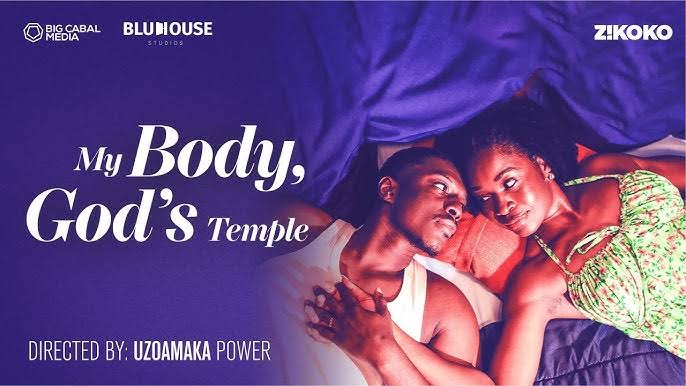
Zikoko Life’s My Body, God’s Temple takes a daring plunge into a rarely explored topic in Nigerian storytelling: the tension between religious teachings and sexual intimacy in marriage. The short film centers on Omasilu (Uzoamaka Power) and Zion (Andrew Yaw Bunting), a newlywed Christian couple who struggle to consummate their marriage. It is on the second day of their wedding that the first signs of this tension show with Oma, still a virgin, finding it hard to loosen up to her husband, an issue that persists for months.
The premise is a beautiful one. We don’t talk enough about couples who wait until marriage for sex, only to find that the intimacy doesn’t happen as naturally or easily as they were led to believe. However, while My Body, God’s Temple attempts to open up this conversation, it doesn’t fully convince us of its central thesis. The film suggests that Oma’s difficulty with intimacy is purely due to the shame and guilt associated with sex which she had internalised from her religious upbringing. While this may reflect the reality of some women raised in deeply conservative homes, the script leans too heavily on this one explanation.
The omission of other plausible factors, such as vaginismus, a painful vaginal contraction during attempted penetration, anxiety or fear disorders, hormonal imbalances or certain medical conditions like endometriosis, and even unresolved relationship tension, is where the storytelling falls short. It’s not that the film has to explore all of these, but somewhat overlooking them weakens the credibility of Oma’s emotional and physical state. If the goal was to show how deeply religious teachings can wire someone’s body and mind to shut down intimacy, then it needed to go further, perhaps show us flashbacks of her upbringing, or deeper internal conflict beyond her soft-spoken resistance.

Even Oma’s conversations with her friends, presumably placed in the film to offer support or balance, feel a little too scripted. They don’t speak with the ease or nuance of real friends trying to unravel complex emotions. Their lines come across more like lectures than genuine dialogue, and this affects the emotional pull the film could have had.
Still, credit must be given where due. The film makes an interesting and commendable attempt to normalise masturbation, not just from the female perspective, but also within the parties in a marriage. When Zion and Oma’s friends speak candidly about it as a way of understanding the body, it subtly pushes against the silence and shame often attached to self-pleasure. However, the way it’s framed, as only acceptable because they’re married, feels a bit dishonest. It’s as though the creators want to push boundaries but are still overly cautious not to offend religious sentiments.
What I particularly liked is the film’s restraint in how it handles sex scenes. In a time where many Nigerian filmmakers throw graphic content at the audience without much meaning, My Body, God’s Temple shows that sexual tension and emotional vulnerability can be communicated without nudity or explicit scenes. This choice is not only smart but also shows respect for storytelling, proving that silence and hesitation can say more than moans and sweat.
The most beautiful takeaway from this part in the series is its subtle affirmation that waiting for sex until after marriage doesn’t always lead to a magical honeymoon, but that patience, communication, and self-discovery can lead to something even more fulfilling. Still, one can’t help but wish that the film had explored the emotional and psychological layers of this idea with more depth and balance.
But maybe that’s the real issue with short films like My Body, God’s Temple. There’s only so much time to dig deep. The film opens up a delicate and important conversation, but because of its limited length, it only scratches the surface. We’re introduced to Oma’s struggle, Zion’s patience, a few friendly chats, and then an eventual soft resolution, but all without the emotional or medical complexity such a situation requires. It’s as though the film is in a hurry to make a statement without giving the characters enough room to live through the discomfort or to properly wrestle with what’s happening.
ALSO READ: REVIEW: No Sign of Weakness: Burna Boy stomps hard on naysayers in 8th studio album
More puzzling, however, is the complete absence of any medical conversation. In real life, a couple who has gone several months without consummating their marriage, especially when it causes emotional distress, would likely consider talking to a professional. A doctor. A therapist. Even a pastor trained in marital counseling. But in the film, no one mentions this. Instead, the characters hover in an emotional bubble, relying mostly on friends and small talk. It’s not that their struggles are invalid, but the refusal to even entertain the idea of medical or psychological help seems a bit unrealistic.

My Body, God’s Temple tries to push a meaningful message but doesn’t fully ground it in real-world nuance. The lack of professional intervention, the narrow focus on religion as the sole cause, and the neat wrap-up all make the film feel more like a morality sketch than an actual story about human complexity. But for its courage to tackle this rarely addressed subject with tenderness and a bit of provocation, it deserves some applause. There’s heart in the performance, especially from Uzoamaka Power, but the writing doesn’t quite stretch far enough to support the weight of what the story wants to do.
Based on their written series, Zikoko Life, is created by Anita Eboigbe and produced by Blessing Uzzi for Bluhouse Studios. The three-part anthology series (What’s Left Of Us, Something Sweet and My Body, God’s Temple) is streaming on Zikoko’s YouTube channel.


