

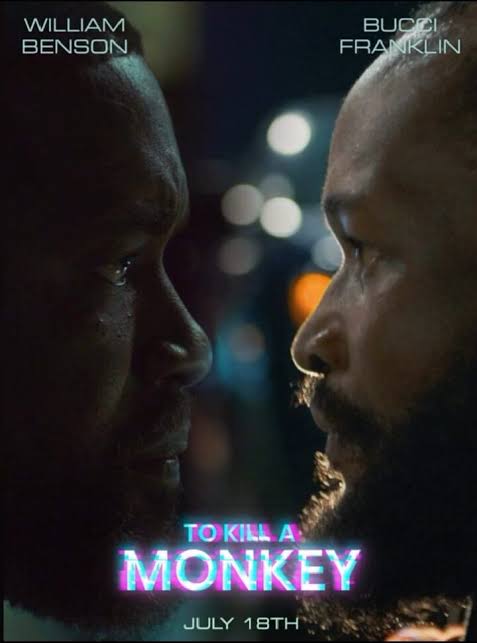
Kemi Adetiba’s To Kill A Monkey, Efemini Edewor (Williams Benson) is your everyday Nigerian hustler: a graduate with no job, buried in debt, torn between the pressures of manhood and the painful realities of a system that crushes ambition. He’s unable to bury his own mother properly, unable to feed his household, and when his wife gives birth to triplets, the weight of existence just becomes unbearable. Then comes a twist of fate: a run-in with his old acquaintance, Oboz (Bucci Franklin), now a rich man, living a soft life. But Oboz’s money is dirty, soaked in crime and danger, the kind Efe tries to avoid, until life corners him and he can no longer run.
If there’s anything Kemi Adetiba has mastered with To Kill A Monkey, it’s her ability to present complex characters in ways that make you pause and reflect. This is not your regular “good guy, bad guy” story. She lets you see the rot, the contradictions, the quiet resilience, and the desperation that drives the characters, particularly Efe. Efe’s struggles are not just his; they mirror the pain of an entire generation. A generation whose dreams are constantly insulted by the economy. A generation choking under the pressure to make it by all means necessary. That’s the beauty of this work: it tells you truths that are hard to swallow, but impossible to ignore.
This emotional depth is further underscored by the dialogues. From Efe’s clashes with his wife’s mother, bosses, to his soul-wrestling conversations with Oboz, every dialogue is layered. It dances between poetry and philosophy. It’s not just people talking, it’s people bleeding. You hear lines that hit like bullets (from Nosa’s mother to Efe, Efe’s bosses to him, and Oboz to Efe), words that sting because they sound like something you’ve told yourself in your darkest moments. To Kill A Monkey reminds me of Tyler Perry’s Straw, but the difference here is, there is no glossy drama. Kemi Adetiba keeps it raw. Painfully raw at that. No razzmatazz. Just life in its undiluted form.
ALSO READ: Choices, Regrets, and Old Flames: The Lost Days Reviewed
In terms of performances, the cast delivers powerfully. Williams Benson as Efe wears his brokenness and educated naivety like a second skin. Bucci Franklin, as Oboz, is the fault line, his eyes glinting with menace, and all too ready to push Efe across that line. And I think now nobody can beat him in this gangster role. This duo is the emotional core of the story, and they both ate their roles, leaving no crumbs.

Beyond the leads, the ensemble works in lockstep. Stella Damasus brings quiet dignity to Nosa as Efe’s devoted wife, her heartbreak palpable in every long, silent shot. Her character reminds you why she’s one of the best to ever do it: an understanding wife at first, then you can also describe her as manipulative and selfish later. Bimbo Akintola’s Inspector Mo offers moral tension; she’s a living reminder of law amid chaos. And Teniola Adelese (Ivie), Chidi Mokeme (Teacher), Lilian Afegbai (Idia), and Sunshine Rosman (Sparkles) inject texture and depth into their roles.
Yet, for all its strengths in acting and dialogue, the series falters in key areas. For instance, Ivie’s hatred for her father was underdeveloped. We never really got to understand the depth of her anger. It came off more to me as rebellion than real resentment, which made her emotional acting feel forced. Also, when Teacher finally dies, it’s not by a key player or through some significant turning point. He’s taken out by faceless, disconnected characters. Anticlimactic doesn’t even begin to cut it. The scene felt like a placeholder, not a payoff.
Adding to this is a pacing problem. To Kill A Monkey drags. Eight episodes to tell a story that could have landed better in six. Too many scenes stretch out emotions we already understand, especially the Oboz-Efe moments in the restaurant and Efe-Amanda moments. Too many subplots that don’t really add weight. You start out gripped, but by the fifth episode, you’re just somehow hoping they get on with it.

Moreover, there were moments in the series that didn’t sit well with me. For instance, when Oboz’s G-Wagon was shot at, the driver should have been drenched in blood, I mean, with bullet holes, blood stains, panic, but the man looked like he just returned from a tea party. Also, the explosion that happened at noon at Teacher’s house wasn’t attended to until night. How do you explain a seven-hour delay before fire services arrived? In a real-life situation, half of Lagos would have been there live with buckets before any official response. Even during the blast scene, Teacher, his daughter, and the guards just stood still like statues—no ducking, no panic, nothing. I was expecting chaos. You’ll also agree with me that the severed hand from the blast looked too clean, the white bead on the wrist still shining like it just came from a boutique, not a bombsite.
Some other small details also disrupted believability. Take Nosa’s artificial nails. For a character who’s supposedly broke and just got sacked, those neatly-done, high-end acrylics didn’t match her reality. These things matter. And let’s not forget the scene where Efe went to spy on Oboz, thinking he was sleeping with his daughter, and instead of parking discreetly, he parked right in front of the gate like it was a wedding ceremony. That’s not how spying works, abeg. At least let there be some logic in the irrational actions of emotional characters.
ALSO READ: ‘Ms Kanyin’ Review: A forgettable attempt at reviving the Madam Koikoi myth
Then there’s the missed opportunity at the heart of it all. To Kill A Monkey had the perfect setup for a biting social commentary. A brilliant man, crushed by poverty, forced into crime in a broken country? In 2025 Nigeria? That should’ve been explosive. But it doesn’t really say much about the society that creates an “Efe”. There’s no real critique of the system. No real confrontation of the rot that traps people. Instead, it veers into some kind of stylized crime power fantasy before rounding off with a tired moral: “Crime doesn’t pay.” That’s not enough. Not today. Not in a country where people are desperate and trying to survive daily.

But despite these shortcomings, To Kill A Monkey succeeds in asking difficult questions about human dignity, sacrifice, trust, betrayal, and the boundaries poverty pushes people to cross. You won’t watch this series and come out the same. It opens your chest. It disarms you. And most importantly, it forces you to look at others with a little less judgment and a little more compassion.
Indeed, the acting is solid. The cinematography, sharp. The dialogue, sometimes brilliant. But the plot? It strays too far from the emotional truth it started with and ends up sounding like a sermon, a worn-out moral lesson we’ve all heard before.
In the end, Kemi Adetiba did not just tell a story. She held up a mirror to a broken society, and whether we like what we see in it or not, she has succeeded in starting a conversation we can no longer afford to run away from. And now that everybody is arguing about what actions are right or wrong, justifiable or otherwise, her success speaks louder.
To Kill A Monkey is streaming on Netflix.


